Introduction
Technology has evolved rapidly over the past few decades, transforming how people communicate, work, learn, and solve complex problems. Traditional computers have become incredibly powerful, enabling everything from internet browsing to artificial intelligence and scientific research. However, as the world’s computational challenges become increasingly complex, scientists and engineers are exploring entirely new approaches to computing. One of the most exciting developments in this field is quantum computing.
Quantum computing is often described as the next major leap in computing technology. Unlike classical computers that process information using bits represented as either 0 or 1, quantum computers use quantum bits, or qubits, which can exist in multiple states simultaneously. This unique capability allows quantum computers to perform certain calculations exponentially faster than traditional computers. Although quantum computing is still in its early stages, researchers believe it could revolutionize industries ranging from healthcare and cybersecurity to finance and artificial intelligence.
What Is Quantum Computing?
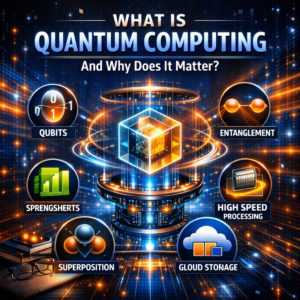
Quantum computing is a type of computing that uses the principles of quantum mechanics, the branch of physics that studies the behavior of particles at the atomic and subatomic levels. Traditional computers use binary bits that can only represent a single value at a time—either 0 or 1. Quantum computers, on the other hand, use qubits, which can represent both 0 and 1 simultaneously through a property known as superposition.
This ability allows quantum computers to process multiple possibilities at the same time. Instead of solving problems step by step like classical computers, quantum computers can explore many potential solutions simultaneously. As a result, they have the potential to solve highly complex problems much faster than even the most powerful supercomputers available today.
Quantum computing does not aim to replace traditional computers entirely. Instead, it is designed to tackle specific types of problems that are extremely difficult or impossible for classical computers to solve efficiently.
How Quantum Computers Work
To understand quantum computing, it is helpful to understand three key principles of quantum mechanics:
1. Superposition
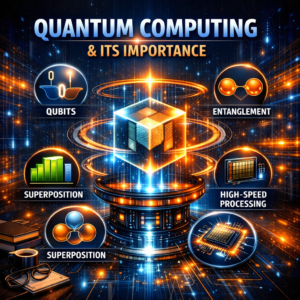
In classical computing, a bit can only be a 0 or a 1 at any given moment. A qubit can exist as both 0 and 1 simultaneously. This property enables quantum computers to perform many calculations in parallel, dramatically increasing computational power.
2. Entanglement
Quantum entanglement occurs when two or more qubits become connected in such a way that the state of one qubit directly influences the state of another, regardless of the distance between them. This allows quantum systems to coordinate complex calculations efficiently.
3. Quantum Interference
Quantum interference helps quantum computers amplify correct solutions while reducing incorrect possibilities. By manipulating quantum states carefully, quantum algorithms can identify the most likely answer more efficiently than traditional methods.
Together, these principles give quantum computers their extraordinary processing capabilities.
Quantum Computing vs. Classical Computing
The differences between classical and quantum computing are significant.
| Feature | Classical Computing | Quantum Computing |
|---|---|---|
| Basic Unit | Bit (0 or 1) | Qubit (0 and 1 simultaneously) |
| Processing Style | Sequential | Parallel |
| Speed for Complex Problems | Limited | Potentially exponential |
| Error Sensitivity | Low | High |
| Current Availability | Widely Available | Experimental |
Traditional computers excel at everyday tasks such as web browsing, word processing, gaming, and business applications. Quantum computers are designed for specialized tasks involving enormous datasets and complex calculations.
Why Quantum Computing Matters
Quantum computing matters because it has the potential to solve problems that are beyond the capabilities of today’s computers. Some calculations would take classical computers thousands or even millions of years to complete, while quantum computers could potentially solve them in minutes or hours.
As data continues to grow exponentially and industries demand more computational power, quantum computing could become a critical tool for innovation. It may help scientists make breakthroughs in medicine, improve climate modeling, optimize transportation networks, and accelerate technological progress across multiple sectors.
The ability to process vast amounts of information simultaneously could unlock discoveries that were previously impossible.
Applications of Quantum Computing
Healthcare and Drug Discovery
One of the most promising applications of quantum computing is in healthcare. Developing new medicines often requires simulating complex molecular interactions, which can be incredibly time-consuming for classical computers.
Quantum computers could model molecular structures with much greater accuracy, helping researchers discover new drugs faster and reduce development costs. This capability could lead to treatments for diseases that currently have limited therapeutic options.
Artificial Intelligence and Machine Learning
Artificial Intelligence relies heavily on processing massive datasets and performing complex calculations. Quantum computing could significantly improve machine learning algorithms by accelerating data analysis and pattern recognition.
Future AI systems powered by quantum technology may be able to learn more efficiently, solve optimization problems faster, and process information at unprecedented speeds.
Cybersecurity and Encryption
Modern internet security depends largely on encryption systems that are extremely difficult for classical computers to break. Quantum computers may eventually be capable of solving mathematical problems that underpin current encryption methods.
While this creates security concerns, it also encourages the development of quantum-resistant encryption technologies that could provide even stronger protection for digital information.
Financial Services
Financial institutions process enormous amounts of data every day. Quantum computing could help optimize investment portfolios, improve risk analysis, detect fraud, and enhance financial forecasting.
Banks and investment firms are already exploring how quantum algorithms might provide competitive advantages in data-driven decision-making.
Climate Research
Understanding climate systems requires analyzing massive datasets and simulating complex environmental interactions. Quantum computing could improve climate modeling accuracy, helping scientists predict weather patterns, monitor environmental changes, and develop strategies for combating climate change.
Challenges Facing Quantum Computing
Despite its enormous potential, quantum computing faces several significant challenges.
Hardware Limitations
Building stable quantum computers is extremely difficult. Qubits are highly sensitive to environmental disturbances such as temperature fluctuations, electromagnetic interference, and physical vibrations.
Maintaining quantum states requires specialized equipment and extremely controlled conditions, often involving temperatures close to absolute zero.
Error Rates
Quantum systems are prone to errors because qubits can lose their quantum properties through a process called decoherence. Researchers are developing quantum error correction methods, but achieving reliable large-scale quantum computing remains a major challenge.
High Costs
Quantum computers are expensive to build, operate, and maintain. Current systems require advanced infrastructure and specialized expertise, limiting accessibility to major research institutions and technology companies.
Software Development
Developing software for quantum computers requires entirely new programming approaches. Scientists and engineers are still creating the tools, languages, and algorithms necessary to fully utilize quantum hardware.
Major Companies Investing in Quantum Computing
Several leading technology companies are investing heavily in quantum research and development.
IBM
IBM Quantum is one of the pioneers in quantum computing and provides cloud-based access to quantum processors for researchers and developers.
Google Quantum AI has achieved significant milestones in quantum research and continues developing advanced quantum systems.
Microsoft
Microsoft Azure Quantum offers quantum development tools and cloud-based quantum computing services.
Amazon
Amazon Braket enables developers to experiment with quantum technologies through cloud computing platforms.
These companies are helping accelerate progress toward practical quantum computing applications.
The Future of Quantum Computing
The future of quantum computing is both exciting and uncertain. While researchers have made remarkable progress, fully realizing the technology’s potential may take years or even decades. Experts believe that quantum computers will initially work alongside classical computers rather than replace them entirely.
As hardware improves and error rates decrease, quantum systems will become more powerful and accessible. Industries such as healthcare, finance, logistics, cybersecurity, and scientific research are expected to benefit significantly from these advancements.
Governments and private organizations around the world continue investing billions of dollars in quantum research because of its transformative potential. The next decade could bring major breakthroughs that reshape how humanity approaches complex computational challenges.
Conclusion
Quantum computing represents one of the most revolutionary technological developments of the 21st century. By leveraging the principles of quantum mechanics, these powerful machines can process information in ways that traditional computers cannot. Although the technology is still developing, its potential applications in healthcare, artificial intelligence, cybersecurity, finance, and climate science are extraordinary.
Challenges such as hardware stability, error correction, and high costs remain significant obstacles, but ongoing research continues to push the boundaries of what is possible. As quantum computing matures, it may unlock solutions to some of humanity’s most complex problems and usher in a new era of scientific and technological innovation.
Frequently Asked Questions (FAQs)
1. What is a qubit?
A qubit is the basic unit of information in a quantum computer. Unlike a traditional bit, it can exist in multiple states simultaneously.
2. Can quantum computers replace traditional computers?
No. Quantum computers are designed for specialized tasks and will likely work alongside classical computers rather than replace them.
3. Why is quantum computing important?
Quantum computing can solve complex problems much faster than traditional computers, potentially revolutionizing industries such as healthcare, finance, and artificial intelligence.
4. Is quantum computing available today?
Yes, but it is still in the experimental stage. Most quantum computers are used for research and development rather than everyday applications.
5. Which companies are leading quantum computing research?
IBM, Google, Microsoft, and Amazon are among the major organizations investing heavily in quantum computing technologies.