Artificial Intelligence (AI) is no longer a futuristic concept found only in science fiction movies. It has become an essential part of modern life, influencing how people communicate, work, shop, learn, travel, and entertain themselves. AI refers to computer systems designed to perform tasks that typically require human intelligence, such as problem-solving, decision-making, speech recognition, and learning from experience. Over the past decade, advances in computing power, data availability, and machine learning algorithms have accelerated AI development at an unprecedented pace.
Today, millions of people interact with AI without even realizing it. Every time someone uses a voice assistant, receives personalized recommendations on a streaming platform, or unlocks a smartphone using facial recognition, AI is working behind the scenes. Businesses are adopting AI to streamline operations, while governments and healthcare organizations are using it to improve public services. The rapid integration of AI into everyday activities demonstrates its growing importance in society. As technology continues to evolve, understanding how AI is reshaping daily life becomes increasingly important for individuals, businesses, and communities around the world.
Understanding Artificial Intelligence
Artificial Intelligence is a branch of computer science focused on creating systems capable of mimicking human intelligence. These systems can analyze data, identify patterns, make predictions, and continuously improve their performance through learning. Unlike traditional software that follows fixed instructions, AI systems can adapt based on new information. This ability allows them to solve complex problems more efficiently and accurately than many conventional methods.
AI technology includes several subfields such as machine learning, deep learning, natural language processing, and computer vision. Machine learning enables systems to learn from data without explicit programming, while deep learning uses neural networks inspired by the human brain. Natural language processing helps computers understand and generate human language, and computer vision allows machines to interpret visual information. Together, these technologies power many of the AI applications people use every day. As AI becomes more sophisticated, its impact on society continues to expand across multiple industries and aspects of daily life.
AI in Daily Life
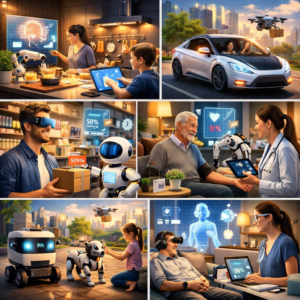
Many people begin their day interacting with AI-powered devices. Smartphones use AI for voice recognition, predictive text, facial recognition, and personalized app recommendations. Virtual assistants such as Siri, Alexa, and Google Assistant can answer questions, schedule appointments, control smart devices, and provide weather updates. These features save time and make everyday tasks more convenient.
Smart home technology has also transformed modern living. AI-powered thermostats learn household routines and automatically adjust temperatures to improve comfort and energy efficiency. Smart security systems can detect unusual activity and send alerts in real time. Even household appliances such as refrigerators, washing machines, and robotic vacuum cleaners use AI to optimize performance. These innovations demonstrate how AI seamlessly integrates into daily routines, making homes smarter, safer, and more efficient than ever before.
AI in Healthcare
Healthcare is one of the most promising areas for AI adoption. Medical professionals increasingly rely on AI-powered tools to assist with diagnosis, treatment planning, and patient monitoring. AI systems can analyze medical images such as X-rays, MRIs, and CT scans with remarkable accuracy, helping doctors detect diseases earlier and more effectively. Early diagnosis often leads to better treatment outcomes and improved patient survival rates.
Personalized medicine is another significant advancement enabled by AI. By analyzing genetic information, medical histories, and lifestyle factors, AI can help healthcare providers create customized treatment plans for individual patients. Wearable devices equipped with AI continuously monitor health indicators such as heart rate, blood pressure, and sleep patterns. These technologies allow healthcare professionals to identify potential issues before they become serious problems. As AI continues to develop, it has the potential to make healthcare more accessible, efficient, and personalized for people worldwide.
AI in Education
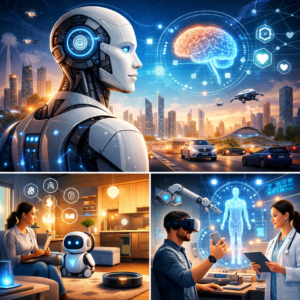
Education is experiencing a major transformation through AI-powered learning tools. Traditional classroom models often struggle to accommodate different learning styles and abilities. AI addresses this challenge by providing personalized learning experiences tailored to each student’s needs. Intelligent tutoring systems can identify strengths and weaknesses, offering customized lessons and exercises to improve understanding and retention.
Online learning platforms use AI to recommend educational content based on individual progress and interests. Teachers benefit from AI-powered grading systems that automate administrative tasks, allowing them to focus more on student engagement and instruction. AI can also support students with disabilities by providing speech-to-text, text-to-speech, and language translation capabilities. These innovations make education more inclusive and effective, helping learners achieve better outcomes regardless of their background or circumstances.
AI in Business
Businesses across industries are adopting AI to improve productivity, reduce costs, and enhance customer experiences. Automation is one of the most significant benefits of AI in the workplace. Repetitive tasks such as data entry, scheduling, inventory management, and report generation can be completed faster and more accurately by AI-powered systems. This allows employees to focus on strategic and creative responsibilities that require human judgment.
Customer service has also been revolutionized by AI. Chatbots and virtual assistants provide instant responses to customer inquiries, improving satisfaction and reducing wait times. AI-driven analytics help businesses understand consumer behavior, predict market trends, and make data-driven decisions. Marketing campaigns can be personalized based on customer preferences and purchasing habits, increasing engagement and conversion rates. As AI technologies continue to advance, businesses that embrace innovation are likely to gain a significant competitive advantage.
AI in Transportation
Transportation is undergoing dramatic changes due to AI-driven innovations. Self-driving vehicles represent one of the most exciting developments in the industry. These vehicles use sensors, cameras, and machine learning algorithms to navigate roads, detect obstacles, and make real-time driving decisions. While fully autonomous transportation is still evolving, many modern vehicles already incorporate AI-powered safety features such as lane assistance, adaptive cruise control, and automatic emergency braking.
Traffic management systems also benefit from AI technology. Smart traffic lights analyze vehicle flow and adjust signal timing to reduce congestion and improve efficiency. Public transportation networks use AI to optimize routes, predict maintenance needs, and enhance passenger experiences. These advancements contribute to safer roads, shorter travel times, and reduced environmental impact. As cities become smarter, AI will play an increasingly important role in creating sustainable transportation solutions.
AI in Entertainment
The entertainment industry has embraced AI to deliver more personalized and engaging experiences. Streaming platforms use recommendation algorithms to suggest movies, television shows, and music based on user preferences and viewing history. These recommendations help users discover content they are likely to enjoy while increasing engagement on digital platforms.
AI is also transforming content creation. Advanced tools can generate music, artwork, videos, and written content with remarkable speed and creativity. Game developers use AI to create realistic characters, adaptive gameplay experiences, and immersive virtual worlds. Social media platforms rely on AI to curate content feeds, identify trends, and moderate harmful material. These innovations demonstrate how AI is reshaping entertainment consumption and production, creating new opportunities for creators and audiences alike.
Challenges and Ethical Concerns
Despite its many benefits, AI presents several challenges and ethical concerns that society must address. Privacy remains a major issue, as AI systems often require large amounts of personal data to function effectively. Questions about data collection, storage, and security have become increasingly important as organizations gather more information about individuals’ behaviors and preferences.
Job displacement is another concern associated with AI adoption. Automation may replace certain routine and repetitive roles, potentially affecting millions of workers worldwide. While AI is expected to create new employment opportunities, workforce adaptation and reskilling will be essential. Ethical considerations such as algorithmic bias, transparency, and accountability must also be carefully managed. Ensuring that AI systems are fair, reliable, and aligned with human values is critical for maintaining public trust and maximizing societal benefits.
Future Outlook of Artificial Intelligence
The future of AI is filled with possibilities that could redefine how humans interact with technology. Advances in machine learning, robotics, and natural language processing are expected to create more intelligent and capable systems. AI may play a crucial role in solving global challenges such as climate change, disease prevention, food security, and sustainable development.
Future AI systems are likely to become more collaborative, working alongside humans rather than replacing them. Smart assistants may become even more intuitive, understanding context, emotions, and complex requests with greater accuracy. Industries such as healthcare, education, manufacturing, and transportation will continue integrating AI to improve efficiency and innovation. As society navigates this technological transformation, balancing innovation with ethical responsibility will be essential to ensuring a positive future for all.
Conclusion
Artificial Intelligence is rapidly changing everyday life, influencing how people communicate, learn, work, travel, and access healthcare. From virtual assistants and smart homes to advanced medical diagnostics and self-driving vehicles, AI is becoming an integral part of modern society. Its ability to process vast amounts of information, identify patterns, and automate complex tasks offers tremendous opportunities for growth and innovation.
At the same time, addressing challenges related to privacy, employment, and ethical decision-making remains essential. The future of AI depends not only on technological progress but also on responsible implementation and governance. By embracing innovation while maintaining human-centered values, society can harness the full potential of AI to create a smarter, safer, and more connected world.
Frequently Asked Questions (FAQs)
1. What is Artificial Intelligence?
Artificial Intelligence is technology that enables computers and machines to perform tasks that typically require human intelligence, such as learning, problem-solving, and decision-making.
2. How is AI used in everyday life?
AI is used in smartphones, virtual assistants, online shopping recommendations, smart home devices, navigation systems, and social media platforms.
3. Can AI replace human jobs?
AI may automate certain tasks and jobs, particularly repetitive ones. However, it is also expected to create new opportunities that require human creativity, critical thinking, and technical expertise.
4. Is AI safe to use?
AI can be safe when developed and used responsibly. Strong regulations, transparency, and ethical guidelines help ensure safe and trustworthy AI systems.
5. What is the future of AI?
The future of AI includes advancements in healthcare, education, transportation, business automation, and scientific research, making technology more intelligent and useful in everyday life.