Introduction
Web development remains one of the most in-demand skills in 2026. As businesses, organizations, and individuals continue to establish their online presence, the need for skilled web developers continues to grow. Whether you’re looking to start a freelance career, build your own website, launch a startup, or secure a high-paying tech job, learning web development is an excellent investment in your future.
The web development landscape has evolved significantly over the years. Modern websites are faster, more interactive, mobile-friendly, and powered by advanced technologies such as Artificial Intelligence (AI), cloud computing, and Progressive Web Apps (PWAs). Despite these advancements, beginners can still enter the field successfully by learning the right fundamentals and following a structured roadmap. This guide will walk you through everything you need to know to start your web development journey in 2026.
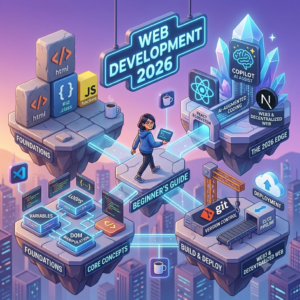
What Is Web Development?
Web development refers to the process of creating and maintaining websites and web applications. It involves everything from designing user interfaces and writing code to managing databases and deploying applications online.
When you visit a website, multiple technologies work together behind the scenes to deliver content and functionality. Web developers build these systems using programming languages, frameworks, databases, and development tools.
Web development is generally divided into three main categories:
Front-End Development
Front-end development focuses on the visual elements users interact with directly. This includes layouts, buttons, menus, animations, and overall user experience.
Back-End Development
Back-end development handles server-side logic, databases, authentication systems, and data processing that users don’t see directly.
Full-Stack Development
Full-stack developers work with both front-end and back-end technologies, allowing them to build complete web applications from start to finish.
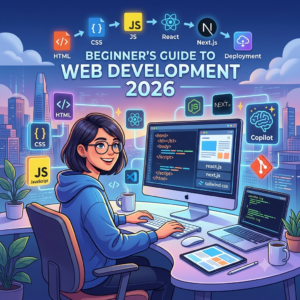
Why Learn Web Development in 2026?
The demand for web developers continues to increase worldwide. Businesses rely heavily on websites and web applications to reach customers, sell products, and provide services. As digital transformation accelerates, web development skills remain highly valuable.
Learning web development offers several advantages:
- High earning potential
- Remote work opportunities
- Freelancing possibilities
- Startup creation opportunities
- Continuous career growth
- Global job demand
Unlike many careers that require expensive degrees, web development can be learned through online resources, practice projects, and real-world experience.
Essential Skills Every Beginner Should Learn
Before diving into advanced frameworks and tools, beginners should master the core technologies that form the foundation of web development.
HTML (HyperText Markup Language)
HTML is the structure of every website. It defines elements such as headings, paragraphs, images, forms, and links.
Think of HTML as the skeleton of a website. Without it, web pages would have no structure or content organization.
Key concepts include:
- HTML elements
- Semantic tags
- Forms
- Tables
- Accessibility basics
CSS (Cascading Style Sheets)
CSS controls the appearance of websites. It allows developers to customize colors, fonts, layouts, spacing, animations, and responsive designs.
In 2026, modern CSS features make website design more powerful than ever.
Important topics include:
- Flexbox
- CSS Grid
- Responsive Design
- Media Queries
- Animations
- CSS Variables
JavaScript
JavaScript brings websites to life by adding interactivity and dynamic functionality.
With JavaScript, developers can create:
- Interactive forms
- Image sliders
- Real-time updates
- Web applications
- API integrations
- Dynamic user interfaces
JavaScript remains the most important programming language for web development in 2026.
Modern Front-End Technologies
Once you’ve mastered HTML, CSS, and JavaScript, you can move on to modern front-end frameworks.
React
React continues to be one of the most popular front-end libraries in 2026. Developed by Meta, React helps developers build fast and interactive user interfaces.
Benefits include:
- Component-based architecture
- Large community support
- High performance
- Reusable code
Next.js
Next.js has become a preferred framework for React developers. It improves performance, SEO, and scalability.
Key advantages:
- Server-side rendering
- Static site generation
- Better SEO
- Faster loading times
Tailwind CSS
Tailwind CSS has transformed modern web design by providing utility-first styling.
Benefits include:
- Faster development
- Consistent design
- Reduced CSS complexity
- Excellent responsiveness
Understanding Back-End Development
The back-end powers the functionality behind websites and applications.
When users log in, submit forms, make purchases, or access personalized content, back-end systems handle these actions.
Popular Back-End Languages
JavaScript (Node.js)
Node.js allows developers to use JavaScript on both the front-end and back-end.
Advantages include:
- Fast development
- Large ecosystem
- Strong community support
Python
Python remains popular due to its simplicity and powerful frameworks.
Popular framework:
- Django
Python is commonly used in:
- Web applications
- AI integration
- Data analysis
- Automation
PHP
Despite being one of the oldest web languages, PHP continues to power millions of websites, including WordPress.
Popular framework:
- Laravel
Learning Databases
Most websites need databases to store information such as user accounts, products, blog posts, and transactions.
SQL Databases
Popular SQL databases include:
- MySQL
- PostgreSQL
These databases organize information using tables and relationships.
NoSQL Databases
Popular NoSQL databases include:
- MongoDB
- Firebase
NoSQL databases offer flexibility for modern applications with large datasets.
Essential Development Tools
Web developers rely on various tools to improve productivity.
Visual Studio Code
Visual Studio Code (VS Code) remains the most popular code editor for beginners and professionals.
Features include:
- Syntax highlighting
- Extensions
- Debugging tools
- Git integration
Git and GitHub
Git is a version control system that tracks code changes.
GitHub allows developers to:
- Store projects online
- Collaborate with teams
- Showcase portfolios
- Contribute to open-source projects
Learning Git is essential for modern web development.
Understanding Responsive Design
Today, most users browse websites using smartphones and tablets.
Responsive design ensures websites work properly across all screen sizes.
Key techniques include:
- Flexible layouts
- Responsive images
- CSS media queries
- Mobile-first design
Google also prioritizes mobile-friendly websites in search rankings.
The Role of AI in Web Development
Artificial Intelligence is becoming an important part of web development.
AI tools help developers:
- Generate code
- Debug applications
- Create content
- Improve design workflows
- Automate testing
However, AI is not replacing developers. Instead, it acts as a productivity tool that helps developers work more efficiently.
Developers who understand both programming and AI-assisted workflows will have a significant advantage in the future job market.
Building Your First Projects
Practice is the most important part of learning web development.
Begin with simple projects such as:
Beginner Projects
- Personal portfolio website
- Calculator
- To-do list app
- Landing page
- Blog website
Intermediate Projects
- E-commerce website
- Weather application
- Social media dashboard
- Task management system
Advanced Projects
- SaaS platform
- AI-powered application
- Online marketplace
- Learning management system
Real-world projects help build confidence and create a strong portfolio.
How to Become a Web Developer in 2026
A practical roadmap for beginners:
Step 1
Learn HTML and CSS.
Step 2
Master JavaScript fundamentals.
Step 3
Build small projects.
Step 4
Learn React and Next.js.
Step 5
Study Node.js or Python.
Step 6
Learn databases.
Step 7
Master Git and GitHub.
Step 8
Create a portfolio website.
Step 9
Start freelancing or applying for jobs.
Step 10
Continue learning advanced technologies.
Following this roadmap consistently can help beginners become job-ready within several months of focused learning.
Common Mistakes Beginners Should Avoid
Many new developers slow their progress by making common mistakes.
Avoid:
- Learning too many technologies at once
- Watching tutorials without building projects
- Ignoring fundamentals
- Skipping responsive design
- Avoiding version control systems
- Comparing yourself to experienced developers
Consistency and practice matter more than speed.
Career Opportunities in Web Development
Web development offers diverse career paths.
Popular roles include:
| Role | Average Demand |
|---|---|
| Front-End Developer | Very High |
| Back-End Developer | High |
| Full-Stack Developer | Very High |
| WordPress Developer | High |
| React Developer | Very High |
| UI Developer | High |
| Freelance Web Developer | Growing |
As businesses continue investing in digital platforms, demand for skilled developers is expected to remain strong throughout the decade.
Conclusion
Web development in 2026 is an exciting and rewarding field with endless opportunities for growth. While modern technologies continue to evolve, the core fundamentals of HTML, CSS, JavaScript, databases, and responsive design remain the foundation of successful web development.
Beginners should focus on building strong fundamentals, creating real-world projects, and learning modern frameworks gradually. With dedication, practice, and continuous learning, anyone can build the skills needed to become a successful web developer. Whether your goal is freelancing, remote work, entrepreneurship, or a full-time tech career, web development provides one of the most accessible and valuable career paths available today.
Frequently Asked Questions (FAQs)
1. Is web development still worth learning in 2026?
Yes. Web development remains one of the most in-demand technology skills worldwide with excellent job opportunities and earning potential.
2. How long does it take to learn web development?
Most beginners can learn the fundamentals within 3–6 months and become job-ready within 6–12 months with consistent practice.
3. Should I learn Python or JavaScript first?
JavaScript is generally recommended first because it is essential for front-end development and can also be used for back-end development.
4. Do I need a computer science degree to become a web developer?
No. Many successful developers are self-taught through online courses, documentation, and practical projects.
5. What is the best web development framework in 2026?
React and Next.js remain among the most popular and widely used frameworks for modern web development.