Introduction
Building a website in 2026 is easier than ever, but choosing the right platform is still a critical decision. Whether you’re a business owner, blogger, freelancer, or startup founder, your website is often the first impression people get of your brand. Two of the most common approaches are using WordPress or building a custom-coded website from scratch.
Both options have strong advantages and clear limitations. WordPress is known for its simplicity, speed of development, and massive ecosystem of themes and plugins. On the other hand, custom websites offer complete flexibility, unique design, and optimized performance tailored specifically to your needs.
The real question is not which one is universally better, but which one is better for your specific goals, budget, and technical requirements. This article breaks down both options in detail to help you make an informed decision.
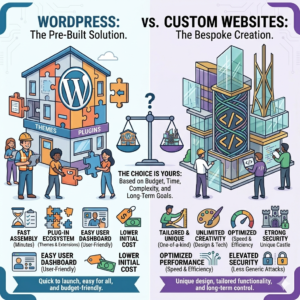
What Is WordPress?
WordPress is a content management system (CMS) that allows users to create and manage websites without needing advanced coding skills. It powers a large portion of websites on the internet due to its ease of use and flexibility.
With WordPress, users can install themes to control design and plugins to add functionality such as contact forms, SEO tools, e-commerce systems, and more. It is widely used for blogs, business websites, portfolios, and online stores.
WordPress can be used in two ways:
WordPress.com
A hosted version where the platform manages everything for you, including hosting and maintenance.
WordPress.org
A self-hosted version where users install WordPress on their own server, giving them full control over customization.
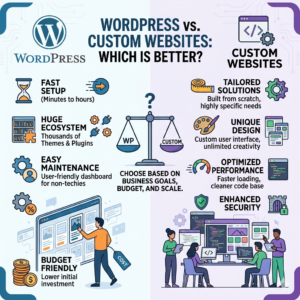
What Is a Custom Website?
A custom website is built from scratch using programming languages such as HTML, CSS, JavaScript, and backend technologies like Python, Node.js, or PHP.
Unlike WordPress, custom websites are not limited by pre-built themes or plugins. Developers design and build every feature according to specific business requirements.
This approach is often used for large-scale applications, startups, SaaS platforms, and businesses that require unique functionality or high performance.
Key Differences Between WordPress and Custom Websites
| Feature | WordPress | Custom Website |
|---|---|---|
| Development Time | Fast | Slow |
| Cost | Low | High |
| Flexibility | Moderate | Very High |
| Performance | Good | Excellent |
| Security | Plugin-dependent | Fully controlled |
| Maintenance | Easy | Requires developers |
| Scalability | Limited | Highly scalable |
| Custom Features | Plugin-based | Fully custom-built |
Advantages of WordPress
1. Easy to Use
WordPress is beginner-friendly and does not require advanced coding knowledge. Users can manage content through a simple dashboard.
2. Quick Setup
A fully functional website can be created within hours or days using pre-built themes and plugins.
3. Cost-Effective
WordPress is significantly cheaper than custom development, making it ideal for small businesses and startups.
4. Large Plugin Ecosystem
Thousands of plugins are available for SEO, security, e-commerce, performance optimization, and more.
5. Strong Community Support
WordPress has a massive global community, making it easy to find tutorials, solutions, and developers.
Disadvantages of WordPress
1. Limited Customization
While flexible, WordPress is still limited by themes and plugin structures.
2. Performance Issues
Too many plugins or poorly optimized themes can slow down websites.
3. Security Risks
Because it is widely used, WordPress is a common target for hackers, especially when plugins are outdated.
4. Dependency on Plugins
Many advanced features rely on third-party plugins, which may conflict or require updates.
Advantages of Custom Websites
1. Full Control
Custom websites are built exactly according to your needs, with no limitations.
2. Better Performance
Since the code is optimized specifically for the project, custom websites are often faster and more efficient.
3. Enhanced Security
Custom-built systems reduce reliance on third-party plugins, lowering vulnerability risks.
4. Scalability
Custom websites are ideal for growing businesses and complex applications that require future expansion.
5. Unique Design
Every element is designed from scratch, ensuring a completely unique user experience.
Disadvantages of Custom Websites
1. High Cost
Custom development requires experienced developers, making it significantly more expensive.
2. Longer Development Time
Building a website from scratch can take weeks or months depending on complexity.
3. Technical Maintenance
Ongoing maintenance requires technical expertise and developer support.
4. Complex Updates
Adding new features or making changes often requires coding knowledge.
When Should You Choose WordPress?
WordPress is the best choice if:
- You want a website quickly
- You have a limited budget
- You are building a blog, portfolio, or small business site
- You prefer easy content management
- You rely on plugins for features like SEO or e-commerce
WordPress is ideal for beginners and small to medium-sized websites.
When Should You Choose a Custom Website?
A custom website is better if:
- You need advanced or unique functionality
- You are building a SaaS platform or web application
- Performance and scalability are top priorities
- You want complete design freedom
- You have a larger budget and development team
Custom websites are best suited for startups, enterprises, and complex digital products.
Performance Comparison
Performance plays a major role in user experience and SEO rankings.
WordPress websites can perform well, but they often depend on optimization techniques such as caching, image compression, and plugin management.
Custom websites, on the other hand, are typically faster because they include only the necessary code without unnecessary features.
SEO Comparison
Both WordPress and custom websites can be optimized for SEO.
WordPress has strong SEO plugins like Yoast SEO and Rank Math that simplify optimization.
Custom websites require manual SEO implementation but offer greater flexibility for advanced optimization techniques.
Security Comparison
Security is a major concern for any website.
WordPress security depends heavily on plugin updates, strong passwords, and proper configuration.
Custom websites allow developers to implement security measures directly, reducing reliance on third-party tools and improving control over vulnerabilities.
Cost Comparison
Cost is often the deciding factor.
WordPress:
- Low initial cost
- Affordable hosting options
- Free or paid themes/plugins
Custom Websites:
- High development cost
- Requires professional developers
- Ongoing maintenance expenses
Future Trends
In 2026, both WordPress and custom development are evolving with AI integration, automation tools, and improved frameworks.
WordPress is becoming more powerful with block-based editing and AI-powered plugins.
Custom development is shifting toward frameworks like React, Next.js, and headless CMS architectures.
The gap between the two is narrowing in some areas, but each still serves different needs.
Conclusion
Choosing between WordPress and a custom website depends entirely on your goals, budget, and technical requirements.
WordPress is perfect for beginners, small businesses, and fast project deployment. It offers ease of use, affordability, and a wide range of features through plugins.
Custom websites are ideal for businesses that need high performance, scalability, and complete control over design and functionality.
Instead of asking which is better overall, the real question is which one is better for your specific situation. Both have their place in the modern web ecosystem, and both continue to evolve with new technologies.
Frequently Asked Questions (FAQs)
1. Is WordPress better than custom websites?
It depends on your needs. WordPress is better for simplicity and cost, while custom websites are better for flexibility and performance.
2. Are custom websites faster than WordPress?
Yes, custom websites are usually faster because they contain optimized, purpose-built code.
3. Can WordPress handle large websites?
Yes, but it may require optimization and careful plugin management for better performance.
4. Which is cheaper: WordPress or custom development?
WordPress is significantly cheaper than custom website development.
5. Which is better for SEO?
Both can be optimized for SEO, but WordPress offers easier tools for beginners, while custom websites allow more advanced optimization.