Introduction
When most people hear the word blockchain, they immediately think of cryptocurrencies like Bitcoin or Ethereum. While it is true that blockchain technology powers digital currencies, its potential goes far beyond financial transactions. In 2026, blockchain has evolved into a foundational technology that is transforming industries such as healthcare, supply chain management, cybersecurity, real estate, voting systems, and even digital identity verification.
At its core, blockchain is a secure and transparent way of recording data that cannot easily be altered or tampered with. This makes it incredibly useful in situations where trust, accountability, and data integrity are critical. Instead of relying on a central authority, blockchain operates through a decentralized network of computers, making it more secure and resistant to fraud.
This article explains how blockchain technology works and explores its real-world applications beyond cryptocurrency in a simple and practical way.
What Is Blockchain Technology?
Blockchain is a distributed digital ledger that records transactions or data across multiple computers in a network. Each record is stored in a “block,” and these blocks are linked together in chronological order to form a “chain.”
Once data is recorded in a block, it becomes extremely difficult to change without altering all subsequent blocks and gaining consensus from the network. This structure makes blockchain highly secure and transparent.
Unlike traditional databases controlled by a single organization, blockchain is decentralized. This means no single entity has full control over the system, reducing the risk of manipulation or corruption.
How Blockchain Works
To understand blockchain, it is important to break it down into simple steps.
1. Transaction Initiation
A transaction or data entry is requested. This could be anything from sending money to recording a medical report or tracking a shipment.
2. Verification
The transaction is broadcast to a network of computers called nodes. These nodes verify the validity of the transaction using predefined rules or consensus mechanisms.
3. Block Creation
Once verified, the transaction is grouped with other transactions into a block. This block contains data, a timestamp, and a unique cryptographic hash.
4. Adding to the Chain
The new block is added to the existing blockchain in chronological order. Each block is linked to the previous one using cryptographic hashes.
5. Distributed Storage
The updated blockchain is stored across all nodes in the network, ensuring transparency and preventing tampering.
Key Features of Blockchain
Blockchain technology has several unique characteristics that make it powerful and secure.
Decentralization
No single authority controls the blockchain. Instead, control is distributed across multiple nodes in the network.
Transparency
All transactions are visible to participants in the network, increasing trust and accountability.
Immutability
Once data is recorded, it cannot be easily changed or deleted, ensuring data integrity.
Security
Blockchain uses advanced cryptographic techniques to secure data and prevent unauthorized access.
Consensus Mechanisms
Nodes must agree on the validity of transactions through systems like Proof of Work or Proof of Stake.
Blockchain vs Traditional Databases
| Feature | Traditional Database | Blockchain |
|---|---|---|
| Control | Centralized | Decentralized |
| Data Modification | Editable | Immutable |
| Transparency | Limited | High |
| Security | Vulnerable to single-point failure | Highly secure |
| Trust Model | Requires trusted authority | Trustless system |
Blockchain Beyond Cryptocurrency
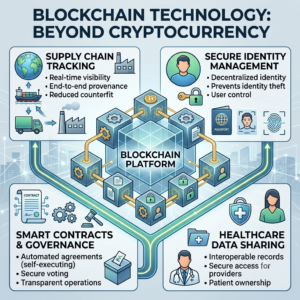
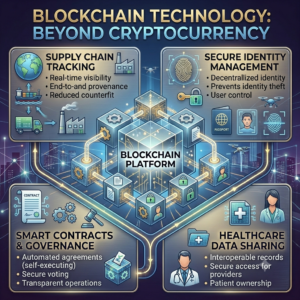
Although blockchain was originally designed for Bitcoin, its applications have expanded far beyond digital money.
1. Supply Chain Management
One of the most powerful uses of blockchain is in supply chain tracking. It allows companies to track products from origin to destination in real time.
For example, food companies can use blockchain to track where ingredients were sourced, how they were processed, and when they were delivered. This improves transparency and helps quickly identify issues during recalls.
It also reduces fraud by ensuring that product information cannot be altered during transit.
2. Healthcare Industry
Blockchain is transforming healthcare by improving data security and patient record management.
Medical records stored on blockchain can be securely shared between hospitals, doctors, and insurance providers without risking data breaches. Patients can have more control over their own health data.
Blockchain also helps in verifying the authenticity of drugs and preventing counterfeit medications from entering the supply chain.
3. Digital Identity Verification
Identity theft is a major global issue. Blockchain provides a secure way to manage digital identities.
Instead of relying on multiple passwords and centralized databases, users can have a single blockchain-based identity that is secure, verifiable, and portable across platforms.
This can simplify login systems, banking verification, and government services.
4. Voting Systems
Blockchain can improve election systems by making voting more transparent and tamper-proof.
Each vote can be recorded as a secure transaction on the blockchain, ensuring that it cannot be altered or deleted. This increases trust in electoral processes and reduces the risk of fraud.
Although still experimental in many countries, blockchain voting has the potential to revolutionize democratic systems.
5. Financial Services Beyond Crypto
Beyond cryptocurrencies, blockchain is used in traditional banking and finance for:
- Cross-border payments
- Fraud detection
- Smart contracts
- Settlement systems
Transactions can be processed faster and with lower fees compared to traditional banking systems.
6. Smart Contracts
Smart contracts are self-executing agreements written in code and stored on the blockchain. They automatically execute when predefined conditions are met.
For example, a smart contract can release payment once a service is completed without needing a middleman.
This reduces delays, lowers costs, and increases trust between parties.
7. Real Estate
Blockchain simplifies property transactions by reducing paperwork and fraud.
Property ownership records can be stored on blockchain, making them transparent and easily verifiable. Smart contracts can also automate property sales, rentals, and lease agreements.
This reduces the need for intermediaries such as brokers and legal agents.
8. Entertainment and Digital Content
Artists, musicians, and content creators can use blockchain to protect intellectual property rights.
Blockchain can verify ownership of digital assets and ensure creators are fairly compensated for their work. NFTs (Non-Fungible Tokens) are one example of blockchain-based digital ownership.
Challenges of Blockchain Technology
Despite its benefits, blockchain also faces several challenges.
Scalability Issues
Blockchain networks can become slow and inefficient when handling large volumes of transactions.
Energy Consumption
Some blockchain systems, especially Proof of Work models, consume significant amounts of energy.
Regulatory Uncertainty
Many governments are still developing regulations around blockchain technology.
Technical Complexity
Implementing blockchain solutions requires specialized knowledge and infrastructure.
Adoption Barriers
Many industries are still in the early stages of adopting blockchain technology.
Future of Blockchain Technology
The future of blockchain is promising as industries continue to explore its potential beyond cryptocurrency. Integration with artificial intelligence, Internet of Things (IoT), and cloud computing will further expand its use cases.
We are likely to see more government adoption, enterprise solutions, and decentralized applications in the coming years. Blockchain may become a core infrastructure technology similar to the internet itself.
As scalability and efficiency improve, blockchain will play a major role in building more transparent, secure, and automated digital systems.
Conclusion
Blockchain technology is much more than the foundation of cryptocurrency. It is a powerful system for secure, transparent, and decentralized data management. From supply chains and healthcare to voting systems and digital identity, blockchain is already transforming multiple industries.
While challenges such as scalability and regulation remain, the potential of blockchain continues to grow. As technology advances, blockchain is expected to become a key building block of future digital infrastructure, reshaping how trust and data are managed in the modern world.
Frequently Asked Questions (FAQs)
1. What is blockchain in simple words?
Blockchain is a secure digital ledger that stores data in linked blocks across a decentralized network.
2. Is blockchain only used for cryptocurrency?
No. Blockchain is used in supply chain management, healthcare, voting systems, identity verification, and more.
3. Why is blockchain secure?
Blockchain uses cryptography and decentralization, making it extremely difficult to alter or hack data.
4. What are smart contracts?
Smart contracts are self-executing programs on blockchain that automatically run when conditions are met.
5. What is the future of blockchain?
Blockchain is expected to expand into many industries, improving transparency, security, and automation in digital systems.